
These exhibits showcase my evolving interest in print-making and digital media as well as my very early work with line drawing.
Click links for details or contact me here for more information.
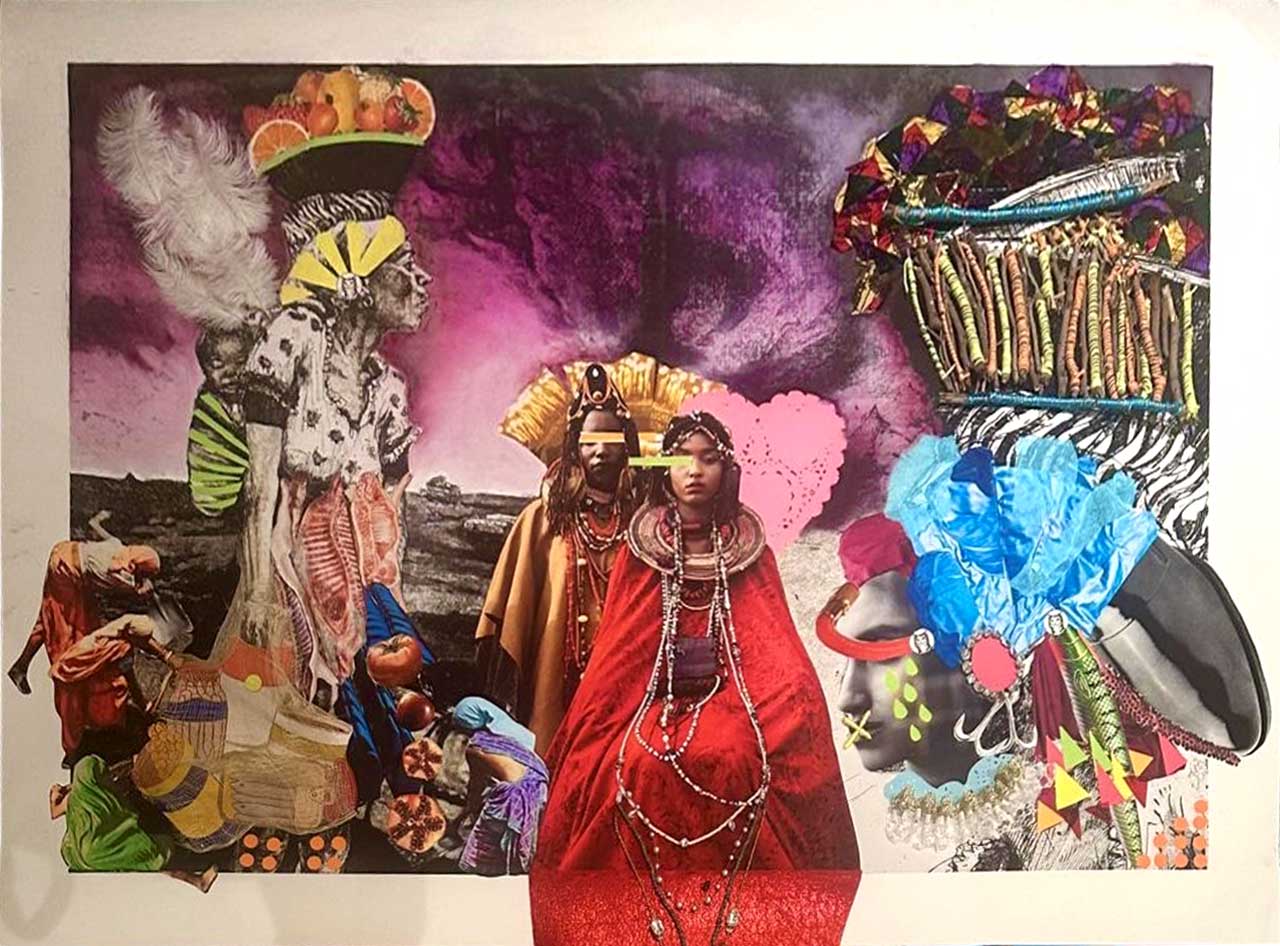
The field is alight with fire, growth and hope. A mother stares onto the horizon but she is laden with domestic responsibilities, preventing her from running forwards. The women in the centre are austere and highly regarded but the decadence of their royalty actually burdens them and holds them captive, unable to move. The anonymous woman on the right cries for help but her tears don’t reach the ground. Her ears are hooked and her consciousness literally down trodden by a shoe that stifles her creativity and expression.
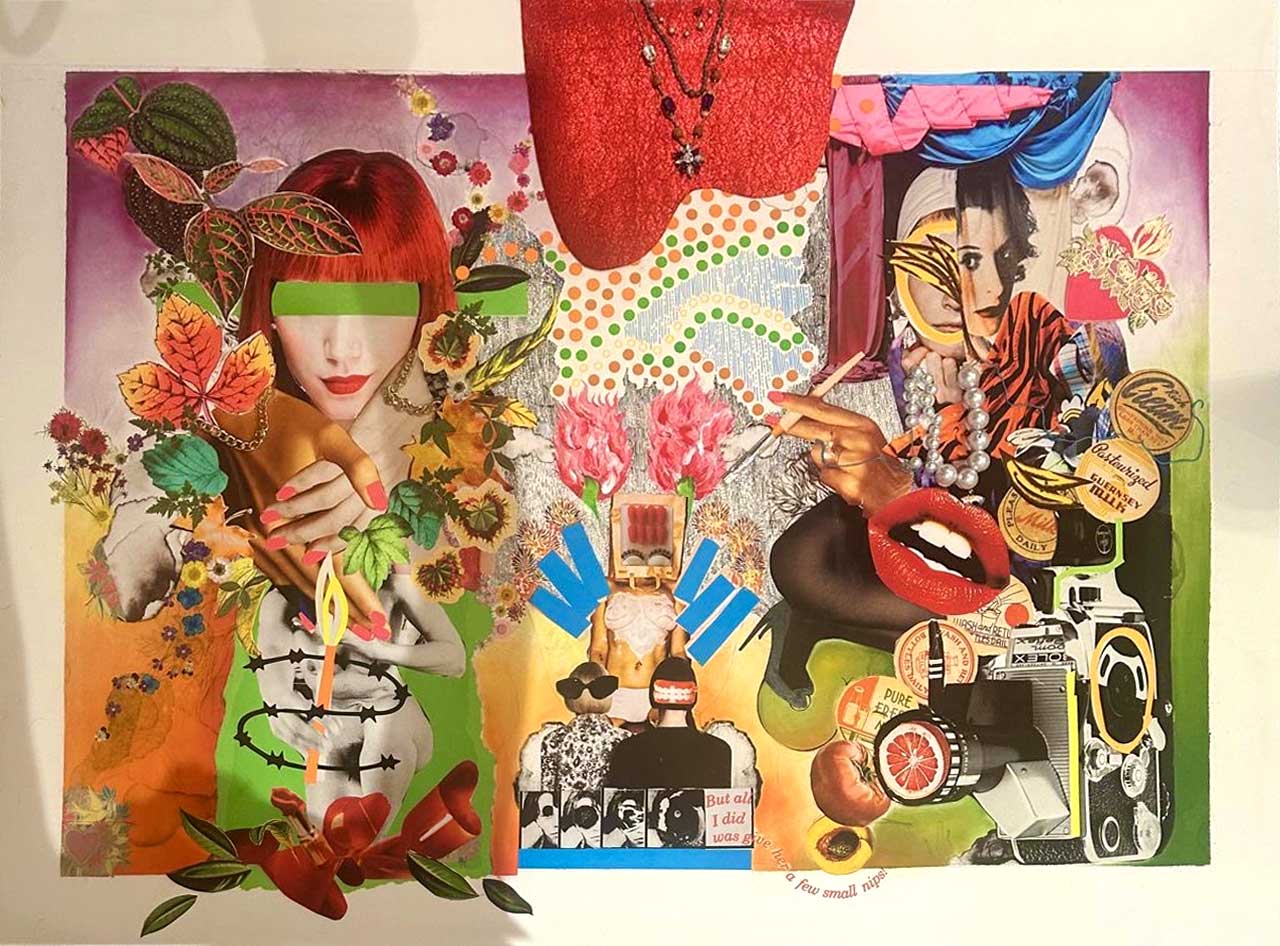
The subjects explore themes about domestic violence and sexual objectification. The amnesty candle is being waved but it is oppressed by the weight of the choking woman: choked by her partner, choked by society’s limitations and choked by the legacy of representing Eve as the disgraceful temptress who some believe instigated the fall of mankind. Despite the oppression she smiles, knowing her potential to evolve beyond these conceptual chains. Her counterpart on the right is paraded on stage but her true personhood remains veiled and hidden. Instead she is reduced to a series of camera clicks before being ushered off stage with a kiss and a slap on the arse.
The advent of artificial intelligence means humans are seeing, doing and making things we never thought to be possible. In a time when we should arguably be our most socially progressive, why is it that women (who constitute 50% of the global demographic) continue to be prejudiced by misogyny and remain the majority victims of domestic violence, inequity, social subordination, sexual objectification and exploitation? Why is it that acts of domestic violence against women have risen 13% globally since 2020? Why are women 76% more likely to be sexualized and objectified in media and pop culture than men? Why are women performing 50—100% more hours per week of domestic duties compared to their male counterparts? This persistent, intrinsic social inequity reinforces foundational and trans-generational attitudes towards women that result in a much bigger problem—these attitudes ultimately have a negative impact on health seeking behaviours, resulting in women spending 25% more of their lives in poor health compared to men (WHO, 2024).
This needs to change. We need to use our technological advances to inform, educate and encourage the younger generations to shift the lens on how women are seen and portrayed in society. Only then can we take steps towards re-building a more balanced future.
This artwork draws on inspiration from feminist artists including Diane Victor, Frida Kahlo, Mary Beth Edelson and Lorna Simpson. It makes direct reference to their work and advocacy as a way of ‘carrying the torch’ forwards. Presenting the core themes of inequity, violence and objectification in a painterly, colourful and almost aesthetically pleasing way, reinforces that even in the face of adversity women are still beautiful and captivating. But if we scratch beneath the surface we see the toxic interplay and symbolism that we need to pick apart and re-arrange.
The mixed collage-print-paint medium is a nod to the collaborative space between innovation, technology and design that we exist in. Each panel exists individually and in unison with the other. The symbolism is discrete but linked, and designed to inspire new thoughts and dialogue with each viewing.

‘Neon Bruises, Velvet Chains’
Following the success of the Clio Art Fair 24th edition show, ‘Neon Bruises, Velvet Chains’ has been extended for exhibition in ‘Downtown-Uptown’.
Venue: Harlem Art House
Duration: 25th September to 5th November 2026
Address: 204W 123rd Street, Manhattan
Social: @harlem_art_house
‘Neon Bruises, Velvet Chains’
This is a two piece exhibition set.
Neon Bruises, Velvet Chains is a mixed media series using collage, print, paint, crayon pastel and textile. More details are available here or visit the gallery.
The exhibitions centre around socio-cultural identity: my dual identity as a medic and artist and how this informs my study and expression of my subjects and subject matter. My print-making exhibition complements my work in women’s health advocacy by celebrating iconic women in history for the ongoing positive social influence they have established. Similarly, the Behind the Grind composition uses stylised imagery to spark awareness and understanding around Domestic Violence which is becoming an increasingly pervasive and prevalent health issue, particularly in the wake of Covid-19.
‘In The Shadows’ and ‘Queens’
This is a two piece exhibition set.
In The Shadows is a photographic series using telephone digital media printed on archival art paper. More details are available here or visit the gallery.
Queens is a print series using copper and zinc etched plates with rosin aquatint overlay. More details are available under Projects - Printmaking page or visit the gallery.

Behind The Grind (BTG) is a coffee cup venture developed by two socially conscious individuals, Sarika and Blaise, who are passionate advocates for increasing awareness and counteracting stigma around domestic violence (DV). The duo used carefully constructed designs printed on coffee cups to celebrate the stories of four DV survivors.
The images (see the gallery page) are linked to a digital platform that highlights the various forms of domestic violence and provides information on avenues for seeking help. The designs are deliberately ambiguous to raise the audience’s curiosity and spark conversation. In 2019, 20,000 coffee cups were circulated between various cafes in theIllawarra region (Southern New South Wales, Australia) to help spread the message.
The venture was applauded by local press for making use of a creative vehicle to sensitively improve awareness around an increasingly important issue.
Learn more about BTG at: www.behindthegrind.net

Travelling the Eastern Distributor is my first exhibited art-work. It is a fusion of the elements that comprise my identity as an Australian born woman of Indian heritage. The iconic imagery, such as the Taj Mahal and the Sydney Opera House, draw on the cultural diversity of my two worlds and attempts to link them through colour, line, form and media. Though appearing disorganised in sections, ultimately the display presents as a coherent spread when the individual sections are viewed collectively—which is a metaphor for my sense of self.
The work incorporates drawing, painting, ink work, photography, digital mixed media and air-brushing techniques. It was my major work for my final year high-school art studies and received state-wide acclaim with inclusion in the Art Gallery of New South Wales (Australia) Art Express exhibition in 2005. ‘Travelling the Eastern Distributor’ can be viewed here.
Sarika Gupta is a Sydney based doctor and artist. She is a highly trained sub-specialist Obstetrician-Gynaecologist-Sonologist who regularly volunteers her medical services in rural and disadvantaged communities throughout South Asia and the Asia Pacific. Her passion for art backdates to her school years, and in 2014 she found a way to combine her interests for medicine and art in advocating for women’s health and wellbeing.
More here
NSW 2000 Australia

info@sgart.com.au


